
High Output Alternators 101 – What You Need to Know
Generally speaking, there are a few things you should be aware of when installing a high output alternator. Installing and wiring it correctly will ensure you get all the performance it’s capable of.
Electrical Considerations
The Charge Lead
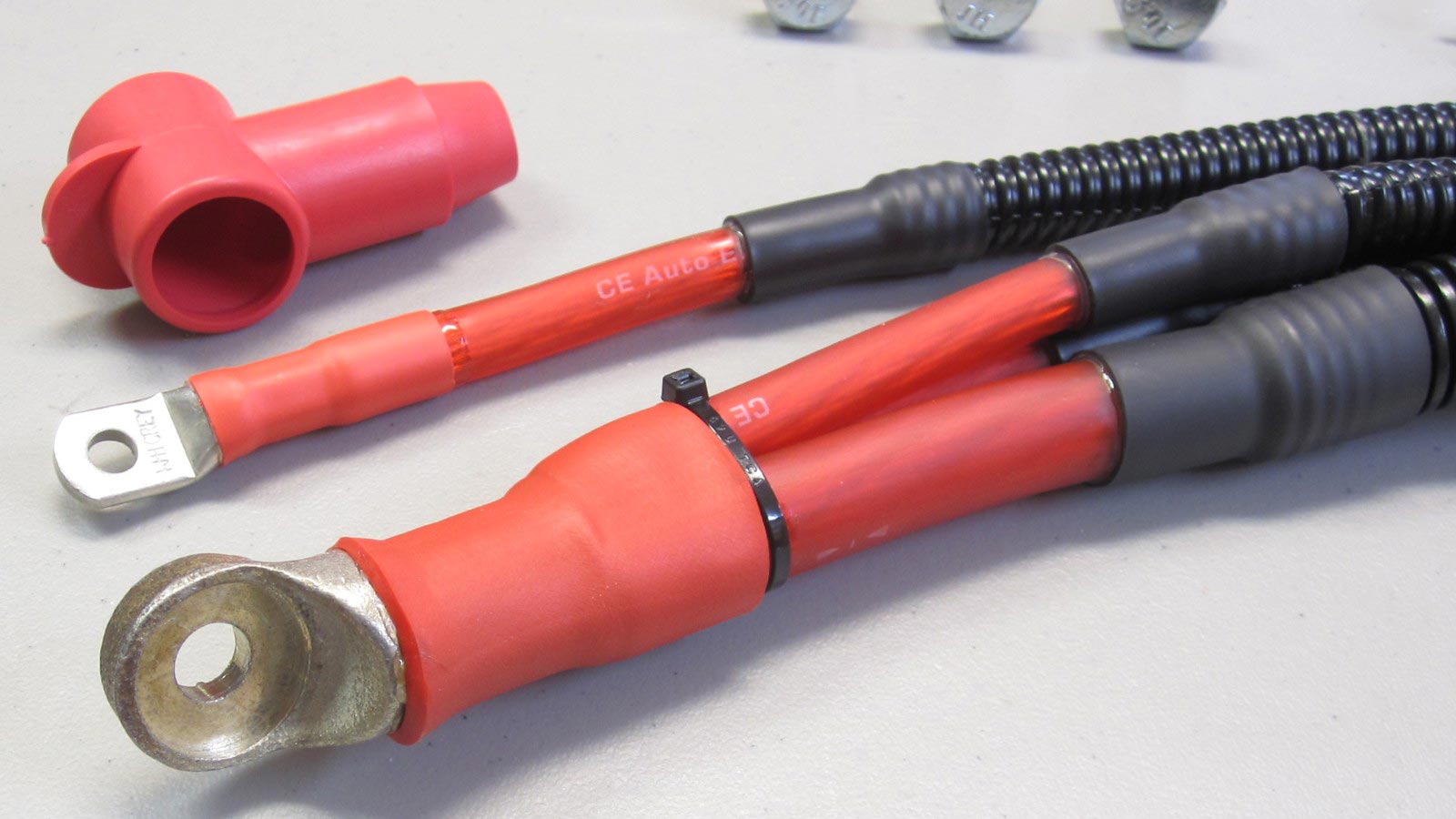
The stock charge lead is typically inadequate for a high output alternator. We recommend the following minimum cable size for traditional installations where the battery is under the hood:
- Alternators making up to 100A – 6 AWG
- Alternators making up to 170A – 4 AWG
- Alternators making up to 225A – 2 AWG
- Alternators making up to 300A – 1/0 AWG
- Alternators making over 300A – 2/0 AWG
We do also offer 3/0 and even 4/0 AWG for very high output or multiple units.
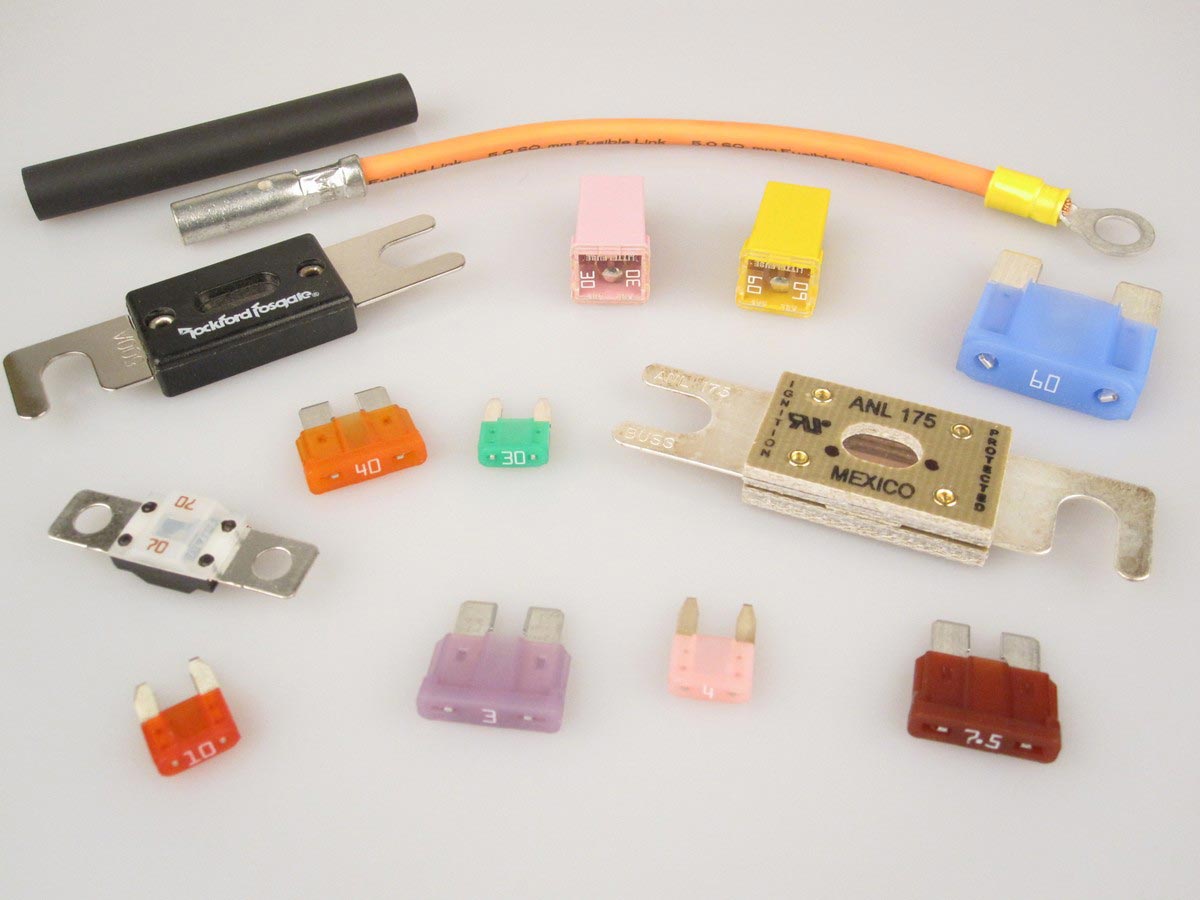
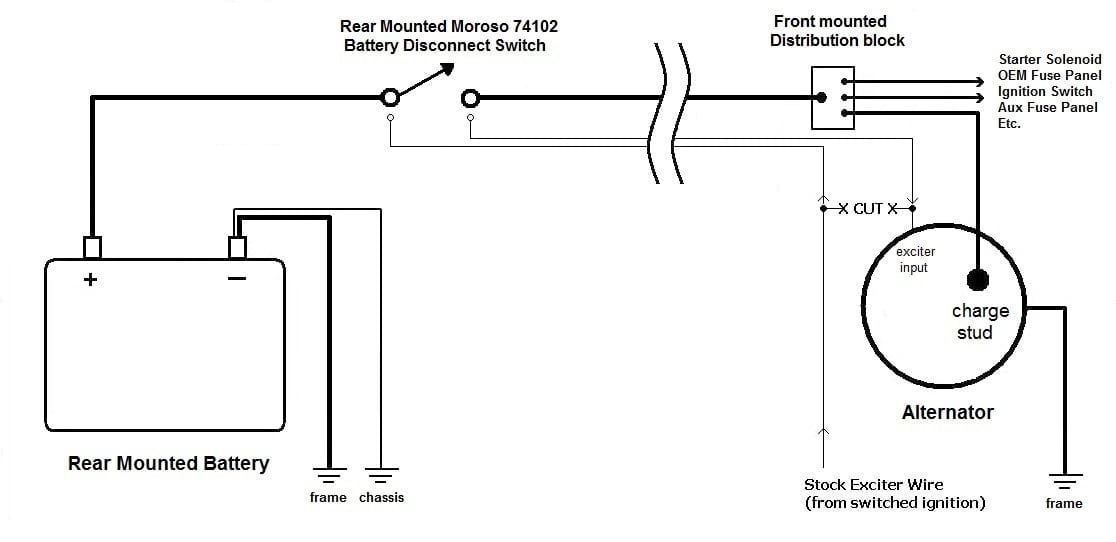
Most OEM charge leads have a fusible link on them. Its purpose is to protect on-board electronics in the event that the regulator fails and causes “voltage run-away.” Although this is quite uncommon, fusing the charge lead of a high output alternator can provide the same protection. Most commonly, we see fusible link wire or JCASE™, MIDI, or MAXI fuses. If you want to preserve this when upgrading your cabling, we offer all of those options as well.
The Return Path
The OEM return path for the alternator is typically as:
- alternator case to mounting bracket
- mounting bracket to cylinder head
- cylinder head to block
- block to battery negative (to keep the battery charged) as well as block to body (vehicle accessories)
The block to body connection can be via:
- a braided ground strap from the engine to the firewall (common on domestic vehicles)
- via the 10 or 12 AWG lead that sprouts from the negative battery terminal to the inner fender (domestic and import)
- via a connection from the heavy negative battery cable to the inner fender of wheel well (many imports)
None are suitable for any alternator capable of making greater than 100A. Therefore, all our alternator wiring kits (or Big 3 Upgrade Kits) include new ground cables to upgrade the return path accordingly. Our testing has shown that without them, you’ll forfeit 20% or more of the output your new alternator is capable of – power you’ve paid for that simply isn’t available to you.

Mechanical Considerations
We must consider drive ratio as it applies to output and maximum shaft RPM and belt tension. Let’s dive into both.
Drive Ratio
Traditionally, an alternator is spun 3x as fast as the crankshaft. This is expressed as 3:1 – alternator shaft rotates 3x for every one rotation of the crankshaft. So, for 1,000 engine RPM, that’s 3,000 alternator shaft RPM.
Drive ratio is easily be calculated as follows:
Drive Ratio = Diameter of the Crankshaft Pulley / Diameter of the Alternator Pulley
Let’s say that you had a 7.5″ diameter crankshaft pulley and a 2.25″ alternator pulley:
7.5 / 2.25 = 3.33, or 3.33:1.
The maximum shaft RPM of our Mechman alternators is 21,500.
Maximum shaft RPM, which is calculated as follows: Shaft RPM = Max Engine RPM x Drive Ratio
In the above example on an engine capable of 6,500 RPM max and the 3.33:1 drive ratio nets a 21,666 Shaft RPM – too much. The drive ratio need be decreased by putting a larger pulley on the alternator. Here are some handy calculations to get this right to begin with:
Shaft RPM / Max Engine RPM = Maximum Drive Ratio
Maximum Drive Ratio / Diameter of Crankshaft Pulley = Maximum Diameter of Alternator Pulley
Belt Tension
The correct tension on a v-belt is when you can grab the belt by hand along its longest length and turn it 90deg only. If you can turn it further than 90deg, it’s not tight enough. We typically do this cold, then run the engine to operating temperature and then check it again, sometimes re-tightening. The belt may seat itself further into the pulleys after some run time. Indications that the belt is not tight enough are squealing on startup (or when your fans kick on) or a hot belt that can actually melt a bit after some run time.
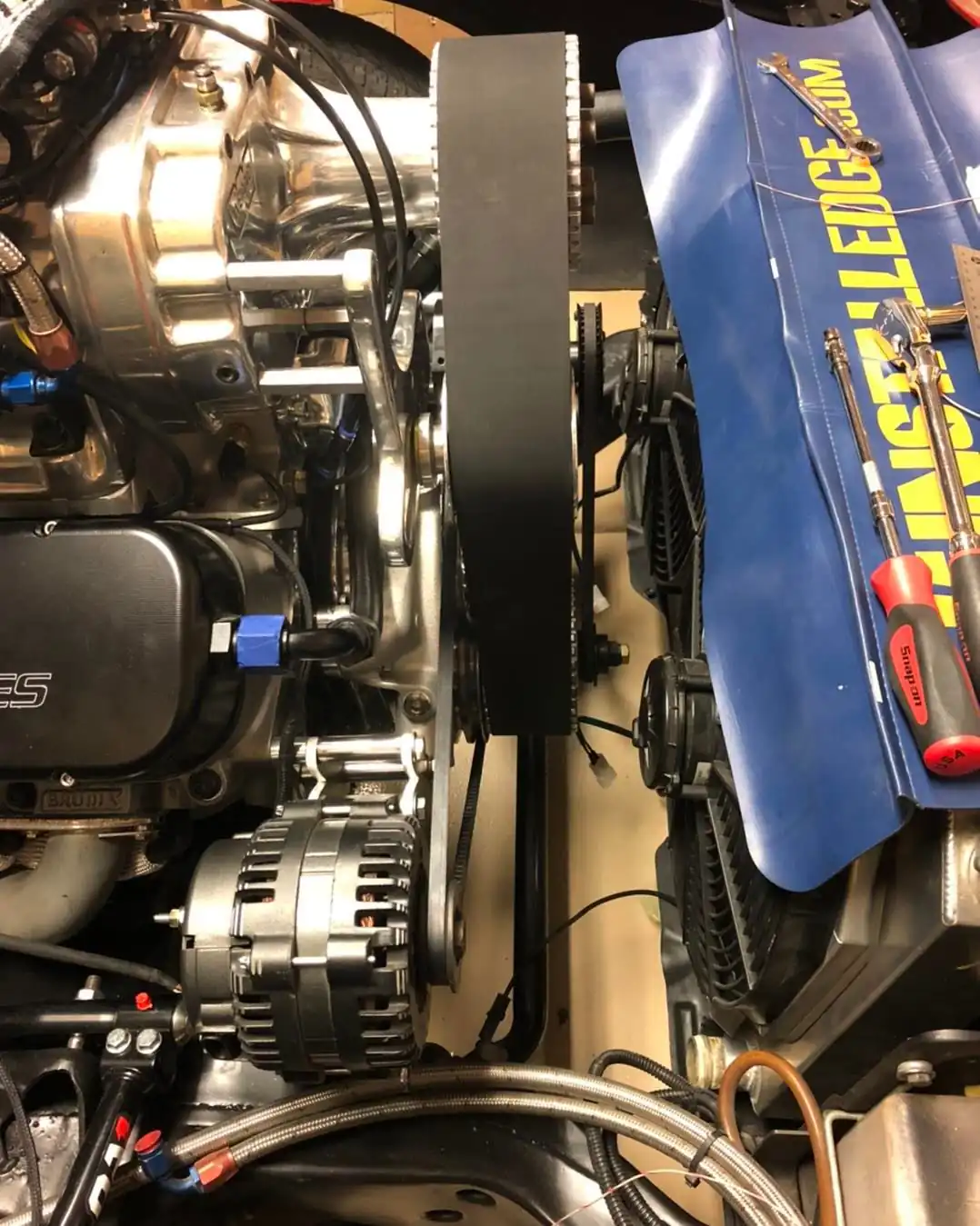
High output alternators place a greater load on the drive belt than the stock unit they’re replacing. Pulleys must be correctly aligned and the alternator pulley must have as much contact surface with the belt as is possible – the more belt wrap the better.
At idle, most of our Mechman alternators are capable of outputting in excess of 140A when driven 3:1. Now, that doesn’t mean that you’ll see 140A when you put an ammeter clamp on the charge lead. What that means is that when the load of the accessories demands it, the alternator can output up to this amount. The proper way to test this is with a carbon pile load.
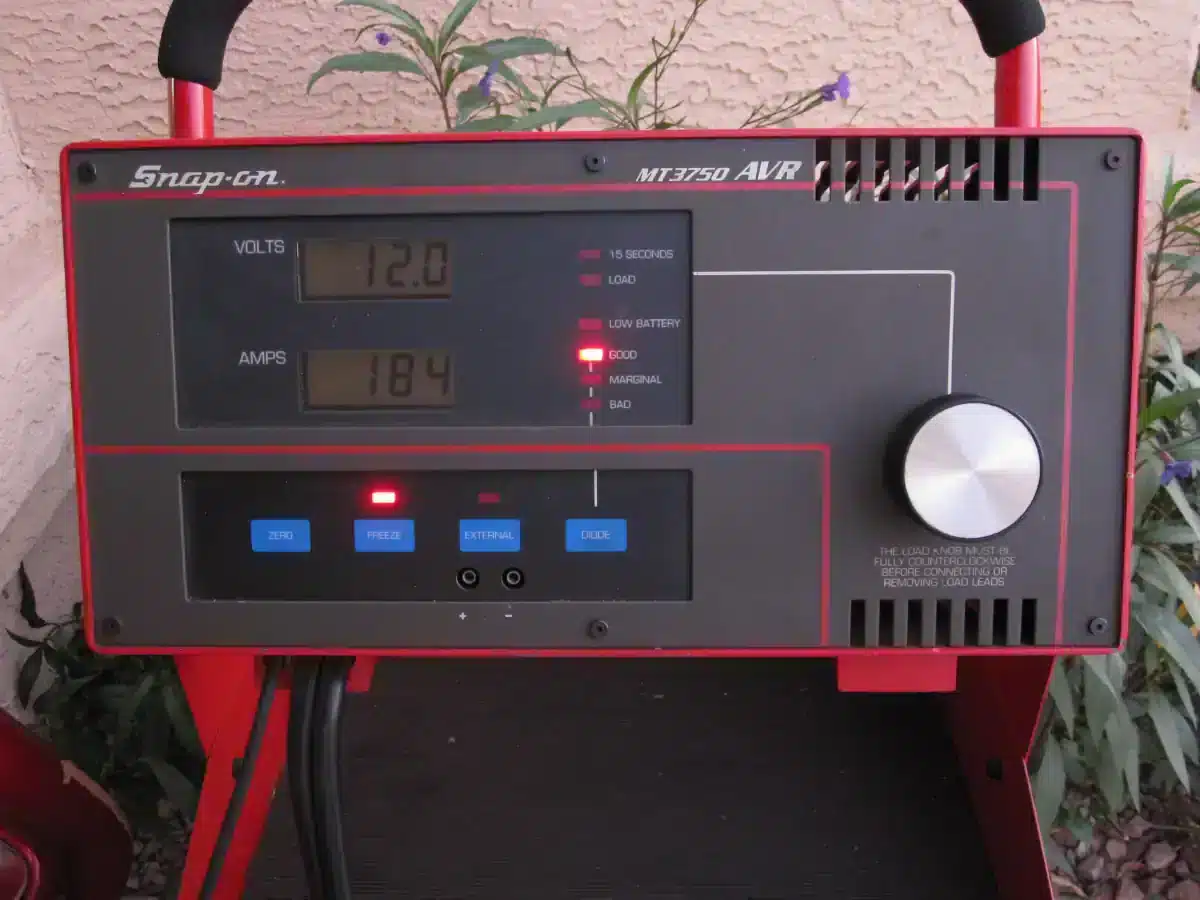
We use a Snap-On MT3750 with an internal 500A carbon pile to achieve this. The load is applied via the carbon pile until voltage at the battery terminals drops to 12V, the output amperage of the alternator recorded, and compared to the rating. We’ve not seen a Mechman alternator yet that wouldn’t achieve the published specs, and often by good margin.
Healthy
Healthy is a function of:
- a correct electrical foundation
- correctly installed from a mechanical aspect
- correctly sized for the application at hand
- properly functioning
Output Voltage
Ideally, we like to see between 13.4 and 13.8V of output at the battery terminals with all accessories ON after the vehicle has reached operating temp, and after the vehicle has been driven a bit. This means that the alternator can deliver all of the current the accessories require, maintain a surface charge on the battery, and there is no risk of overcharging the battery. For example, many think 14.8V is better than 13.8V. About the only thing that’s better at is shortening the life of a battery, and dramatically if it’s an AGM. Such high voltage will boil the electrolyte out of a flooded lead acid battery over time as well but such a battery can live longer than an AGM when being subjected to this.
Performance
When a charging system is properly wired with cable of the correct gauge, accessories wired with the correct wire gauge, and all terminations done by the book, the voltage drop of highly inductive loads (like fans) are actually amplified. This is because current can be delivered and isn’t caught up in the bottleneck of poor connections, undersized wiring, etc. For example, kicking a big pair of fans on high speed can absolutely cause a BIG voltage dip which can be seen on a voltmeter, dimming lamps on the dash, etc. The regulator of the alternator does not respond fast enough to increase its output with such a dip (which is measured in milliseconds) as it monitors the charge state of the battery. However, a new, fresh battery made of virgin lead with low ESR – say an XS Power – can absolutely minimize this.
We offer All the Parts to make is Easy!
Alternators
We stock a nice variety of Mechman High Output Alternators, including some universal models which perfectly fit many General Motors vehicles made from 1963-1985.
Battery Cable
We stock Battery Cable in Red and Black in 8 AWG, 6 AWG, 4 AWG, 2 AWG, 1 AWG, 1/0 AWG, 2/0 AWG, 3/0 AWG, and even 4/0 AWG sizes.
Eyelets, Battery Terminals, Etc,
We stock a huge variety of the Individual Components used to build and protect cables, and even the tools required to install them.
Custom Cable Builders
Our Custom Cable Builders allow you to easily build and order cables to your exact specifications – you can watch the cable come together live as you build it!
Take your time installing your new alternator with quality cables and components from CE Auto Electric Supply and the effort will pay off in spades.